
Global Livestreaming Landscape 2025: YouTube Live strengthens positions, Twitch viewership down 10%
By 2025, the livestreaming market had become brutally competitive. Platforms were fighting simultaneously for creators, viewers, infrastructure capacity, regulatory breathing room, and clean metrics they could actually trust.
That pressure exposed sharp differences in how platforms evolved over the last year. Some continued to grow aggressively, expanding live consumption through tighter product integration and discovery. Others moved more cautiously, constrained by their own scale and legacy systems. And a third group saw audiences decline, sometimes organically, sometimes as a direct result of intensified efforts to clean up bots and low-quality traffic in general.
The contrast between major players became especially visible. TikTok kept closing the gap with YouTube in terms of live content consumption, pushing livestreaming deeper into its core product loop. Twitch, by comparison, showed clear signs of stagnation as it focused on moderation, monetization clarity and metric integrity rather than expansion. Kick, meanwhile, posted some of the fastest growth in the market over the year, even if the final quarter marked its first period of negative momentum since launch.
Outside the top tier, volatility was even more pronounced. Smaller and regional platforms experienced sharper swings in viewership, often tied to infrastructure limits, policy changes, or shifts in creator behavior. In South Korea, however, local platforms continued to build on the structural reset of previous years, steadily expanding their audiences and deepening user engagement. Strong domestic ecosystems helped absorb broader market turbulence, making Korean services some of the most resilient players outside the top tier.
YouTube Live: the structural heavyweight
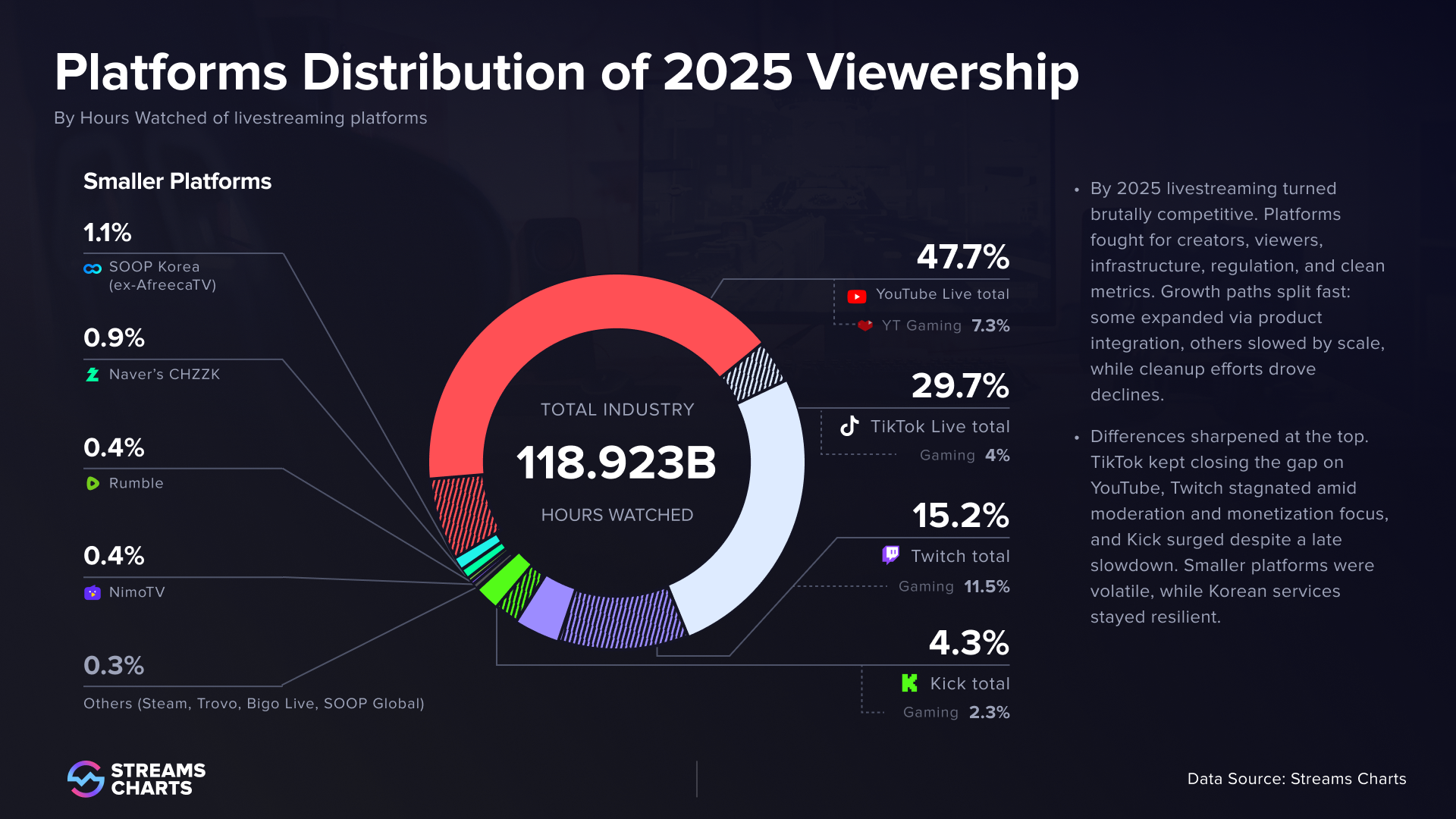
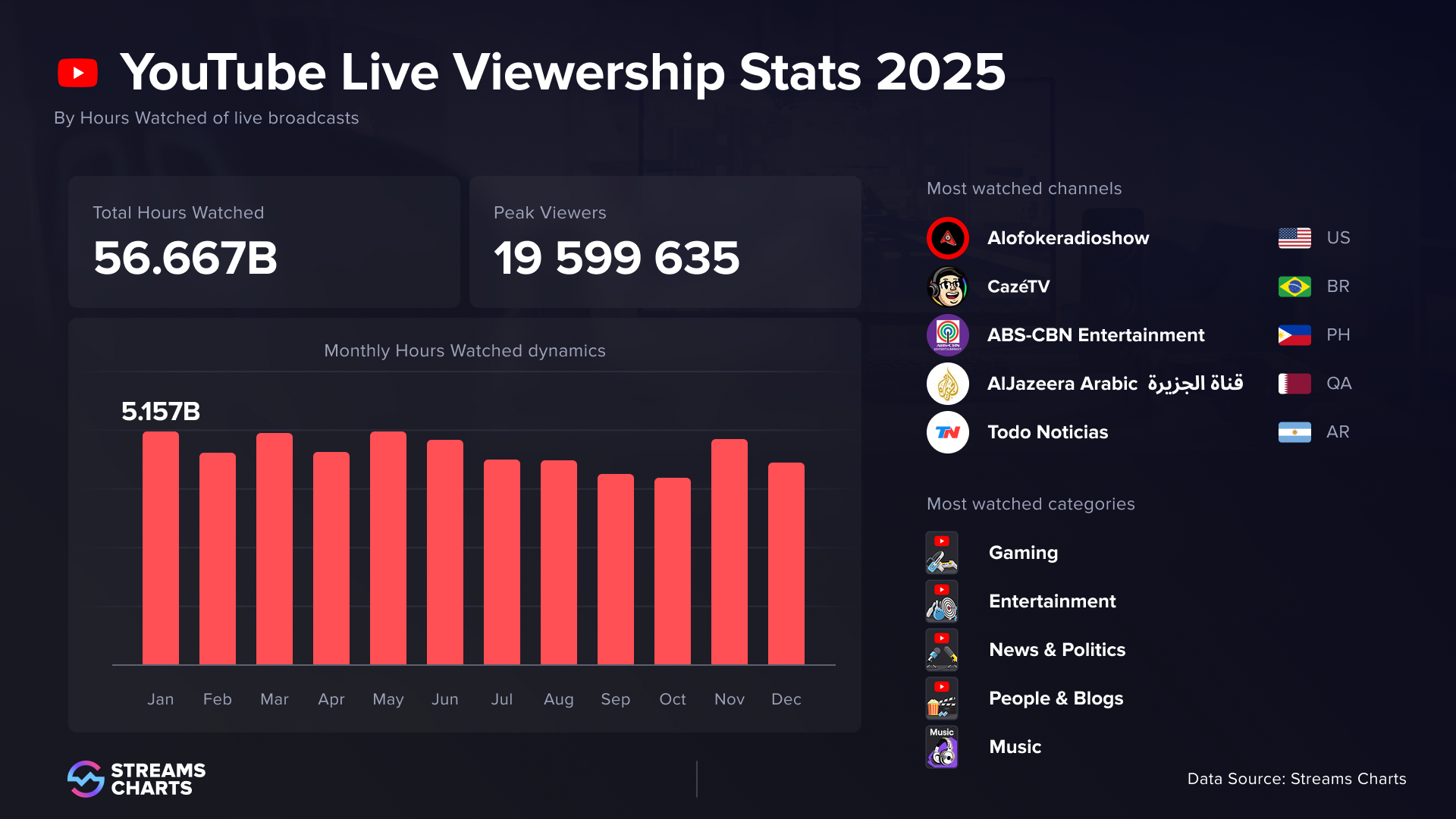
By the end of 2025, YouTube accounted for more than 47% of total livestreaming Hours Watched across global and local platforms outside mainland China. Not an absolute monopoly, but a clear structural majority. This position is less about short-term momentum and more about gravity.
At this scale, YouTube is no longer a platform that can grow at the breakneck pace seen in younger services. The law of large numbers applies. Yet even under those constraints, YouTube still expanded its total Hours Watched by around 2% year-over-year, reinforcing its role as the market’s most stable anchor.
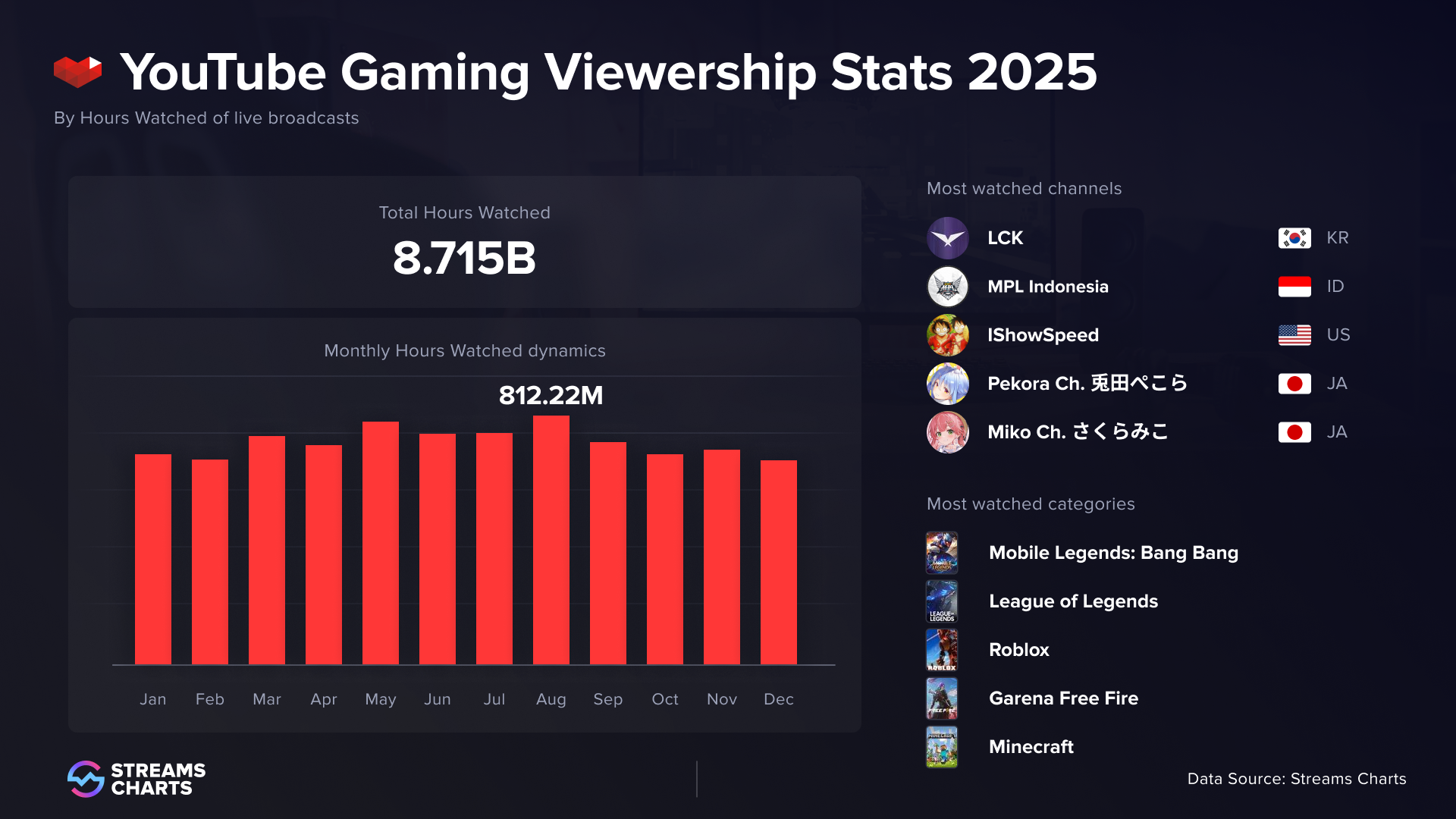
YouTube’s strength lies in its ability to aggregate audiences globally while remaining locally dominant across most regions. It supports the broadest range of live content in the industry, from news and politics to entertainment, sports, and esports. Gaming remains the most popular category overall, but YouTube’s real advantage is that it does not depend on any single vertical. Livestreams are tightly embedded into the broader YouTube ecosystem, benefiting from recommendations, VODs, Shorts, and long-tail discovery. This structural universality is what keeps YouTube firmly in first place, even as its growth naturally moderates.
TikTok Live: scale first, specialization later
With close to 30% of total livestreaming Hours Watched, TikTok firmly established itself as the second-largest force in live content consumption. The gap to YouTube remains substantial, but TikTok is no longer operating in the shadow of traditional livestreaming platforms. It has built its own lane.
TikTok Live’s strength lies in mobile-first consumption and habitual usage. Livestreams are deeply embedded into the core TikTok experience, blending seamlessly with short-form content, social interaction, and increasingly, commerce. This has allowed TikTok to capture enormous volumes of live watch time even without relying heavily on gaming.
At the same time, gaming remains a relatively smaller share of TikTok Live compared to other major platforms. That also signals opportunity. Gaming live content has been steadily expanding on TikTok, and given the platform’s distribution mechanics, it remains one of the clearest growth vectors heading into 2026. TikTok may still trail YouTube in absolute scale, but it continues to close the gap in how central livestreaming is to everyday audience behavior.

Twitch: gaming remains the pillar
Despite its entrenched position, Twitch was the only major livestreaming platform to end 2025 with a negative year-over-year result. Over the course of the year, the platform consistently lost Hours Watched on a monthly basis and finished roughly 10% below its 2024 total.
Part of this decline can be attributed to intensified efforts to clean up the platform. Twitch has long struggled with bot-driven inflation and artificial engagement, and stricter enforcement inevitably removed a portion of low-quality or non-organic viewership from the system. In that sense, some of the drop reflects cleaner metrics rather than pure audience loss.
At the same time, competition played a real role. Twitch is the most gaming-centric of the major platforms, and that also makes it the most exposed to creator migration. A noticeable share of gaming creators and their audiences shifted toward alternatives such as Kick, contributing to Twitch’s erosion in total watch time.
Even so, Twitch still captured over 15% of total Hours Watched across the livestreaming market in 2025, with gaming remaining its dominant pillar. Non-gaming content continues to grow, but games still define the platform’s identity.
Kick: explosive growth meets its first ceiling
In 2025, Kick recorded one of the fastest expansions in the entire livestreaming market, growing its total Hours Watched by approximately 125% year-over-year. That surge pushed the platform to more than 4% of total global livestreaming watch time, an impressive result for a service that has been operating for just over three years.
However, the final quarter of the year marked a turning point. Q4 2025 became the first quarter in Kick’s history to show a decline in Hours Watched, signaling a shift from hypergrowth to stabilization. While the platform remains far larger than it was a year earlier, the data suggests that its current growth model may be approaching a short-term ceiling.
Kick has clearly found its niche, driven by creator-friendly monetization terms, looser content constraints, and successful talent acquisition. The open question is what comes next. Maintaining its current share looks achievable, but further outsized growth will likely require new structural drivers that attract not only creators, but new audiences at scale. Without that, Kick’s trajectory appears to be moving from disruption toward consolidation.
Beyond the market leaders: regional strongholds and fragile niches
Outside the major platforms, the livestreaming landscape in 2025 was far more uneven. This segment combined local success stories, politically driven spikes, and platforms that struggled to remain relevant under mounting competitive pressure. Together, these services accounted for only a small share of total Hours Watched, but their trajectories help explain where volatility in the market is most concentrated.
The clearest winners in this group were the Korean platforms SOOP and CHZZK, with the latter standing out in particular. Both continued to build on the structural realignment of the Korean market, posting solid year-over-year growth in Hours Watched, at +12% for SOOP Korea and +41% for CHZZK. CHZZK also crossed a symbolic milestone, surpassing 1 billion Hours Watched in a single year, underscoring how firmly local services have embedded themselves into domestic viewing habits. Rather than chasing global scale, these platforms benefited from strong ecosystem integration and stable creator bases, making them resilient compared to other mid-tier services.

A very different dynamic played out on Rumble. After a surge in relevance at the end of 2024 and early 2025, driven largely by political content and heightened attention around the U.S. presidential transition, the platform cooled off over the remainder of the year. By the end of 2025, Rumble finished down 14% in Hours Watched year-over-year. This decline appears largely organic, reflecting the fading of a specific news cycle rather than a structural collapse. At the same time, Rumble’s trajectory remains tightly linked to global political turbulence. Periods of heightened geopolitical or U.S.-centric political tension are likely to continue acting as demand catalysts for the platform.
The weakest performance in this segment came from Nimo TV, which saw its Hours Watched fall by more than half (-54%) over the year. In 2024, Nimo ranked among the stronger mid-tier platforms, second only to SOOP Korea within this group. By the end of 2025, it had slipped to fourth place, clearly losing ground to competitors. The scale of the decline points not just to market volatility, but to a deeper competitive issue, as Nimo struggled to defend its position against both local alternatives and larger global platforms.
The remaining platforms delivered mixed but generally subdued results. Steam TV posted strong growth in Hours Watched, but a significant share of its volume continues to come from autoplay, making its viewership less directly comparable to creator-led platforms. Trovo and Bigo Live both ended the year lower than in 2024, though their declines were far less severe than Nimo’s. Meanwhile, SOOP’s international segment showed modest growth, a positive signal for the platform’s long-term ambitions, but still far from enough to position it as a serious challenger outside its home market.
YouTube Live in 2025
In 2025, YouTube doubled down on making Live structurally indistinguishable from the rest of the platform. Livestreams became more deeply woven into Shorts distribution, Home recommendations, and post-stream monetization via replays. Technical work focused on reliability rather than spectacle: better low-latency stability, more consistent 4K delivery and stronger AI-driven chat moderation. The key shift was not growth acceleration, but making live content behave like a first-class citizen across YouTube’s entire content loop.
TikTok Live in 2025

TikTok spent much of 2025 tightening control rather than pushing volume. The platform invested heavily in live commerce infrastructure, seller verification, payout delays and real-time moderation tools to curb fraud and abuse. At the same time, it quietly optimized backend support for longer live sessions, signaling a move away from purely short, chaotic streams. TikTok Live’s numbers increasingly reflect system-level maturity rather than experimentation.
Twitch in 2025

For Twitch, 2025 was defined by internal cleanup. The platform expanded anti-bot detection, refined AutoMod, and clarified monetization rules, even when those changes risked suppressing raw watch time. Twitch also began rolling out higher-quality streaming options and testing dual-format output, but without aggressive promotion. The year reads less like a push for scale and more like an attempt to stabilize a mature, gaming-centric ecosystem under competitive pressure.
Kick in 2025
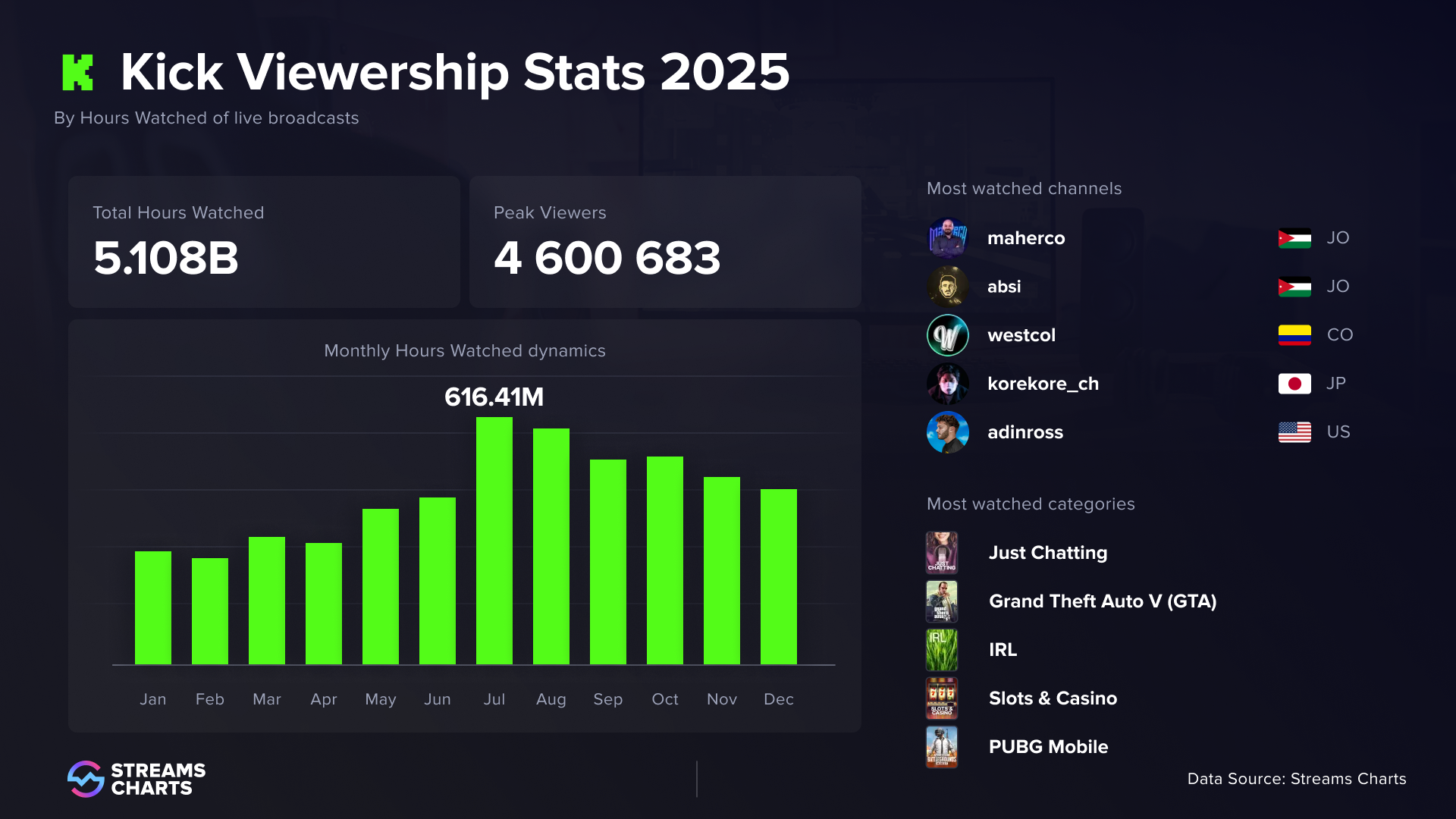
Kick’s focus in 2025 shifted from pure creator acquisition to operational hardening. The platform expanded KYC requirements, improved payout safeguards and invested in backend scalability to handle peak loads more reliably. Developer-facing moves, such as API access and third-party tooling support, signaled a longer-term ecosystem play. The slowdown visible in late 2025 coincided with fewer new incentive layers being introduced, exposing how dependent early growth had been on aggressive economics.
SOOP & CHZZK in 2025


Korean platforms used 2025 to entrench, not expand recklessly. CHZZK benefited from deep integration with Naver’s services, improving discoverability and stream quality for domestic users, while SOOP continued refining creator tooling and localized formats. Both platforms invested in AI features such as automated highlights and real-time translation, reinforcing stickiness rather than chasing global audiences.
Rumble in 2025

Rumble’s live segment in 2025 remained highly context-dependent. Product-side, the platform expanded live infrastructure and experimented with AI-powered discovery and search, but without fundamentally changing user behavior. Engagement continued to spike around political events rather than creator-led formats.
Nimo TV in 2025
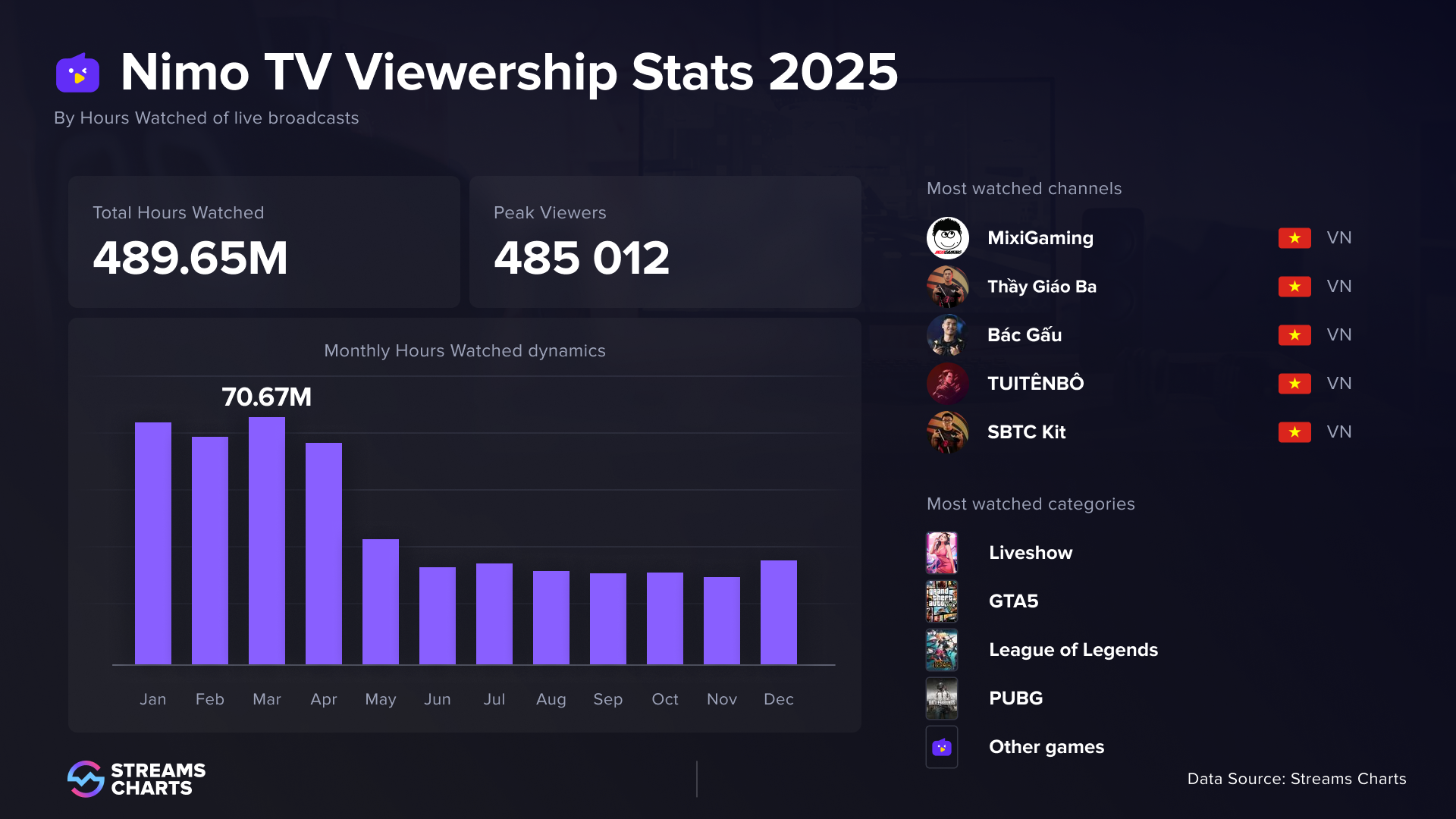
Nimo entered 2025 with limited strategic momentum. While maintaining activity in select regions, the platform introduced few meaningful product or ecosystem upgrades during the year. As competitors strengthened moderation, monetization, and discovery, Nimo struggled to differentiate. The sharp decline visible in the data aligns with a broader loss of relevance rather than a temporary fluctuation.
Steam TV, Trovo, Bigo Live in 2025
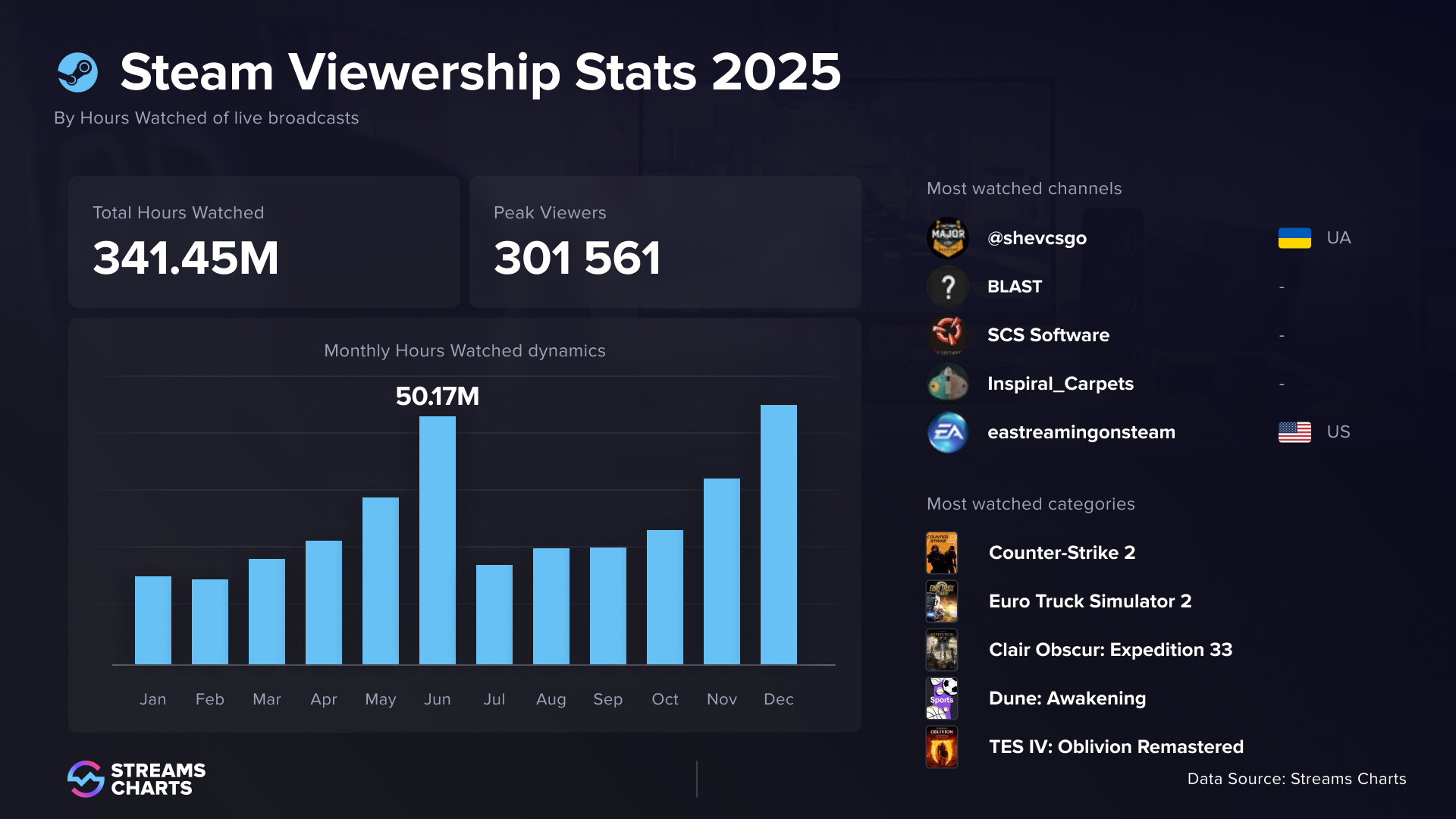


Among the remaining platforms, 2025 was less about reinvention and more about containment. Steam TV benefited from event-driven exposure and autoplay mechanics rather than creator ecosystems. Trovo and Bigo Live focused on incremental moderation and monetization updates while defending existing regional audiences. Their trajectories show how difficult it has become for mid-tier platforms to generate organic growth without a strong differentiating axis.
Subscribe to our newsletter.
Latest streaming statistics and analytics news in weekly format!
Subscribe