Q1 2026 Global Livestreaming Landscape: TikTok declines by over 11% in viewership

The first quarter of 2026 marked a period of intense competition in the livestreaming market, where even minor structural shifts had an immediate impact on performance metrics. In this environment, any growth in viewership counted as a meaningful win, as many established platforms continued to lose audience share. While some services successfully consolidated their positions and strengthened their market presence, others failed to withstand the operational pressure and exited the market.
At the same time, the industry sees a continuous shift from global expansion strategies toward deep localization. This transition is increasingly shaping content consumption patterns and directly influencing engagement across regions. This report by Streams Charts examines the performance of leading platforms and highlights the key events that defined the livestreaming landscape in Q1 2026.
Major takeaways
Market leaders YouTube Live and TikTok Live both recorded a decline in live content consumption, with the latter dropping by over 11%. This decrease may be partly linked to the transition of TikTok’s U.S. segment under domestic jurisdiction.
In contrast, the main competitors in the gaming segment, Twitch and Kick, showed positive growth. Among all platforms, the Amazon-backed Twitch demonstrated the strongest performance, supported in part by the launch of new competitive seasons across the esports industry.
The Korean platform SOOP completed a consolidation of its internal systems but still experienced a minor decline in viewership metrics, allowing its primary competitor CHZZK to further close the gap in audience reach.
Trovo announced the upcoming shutdown of its livestreaming functionality, leading to a sharp drop in audience figures to record-low levels.
Livestreaming content consumption Q1 2026: Breakdown by platforms
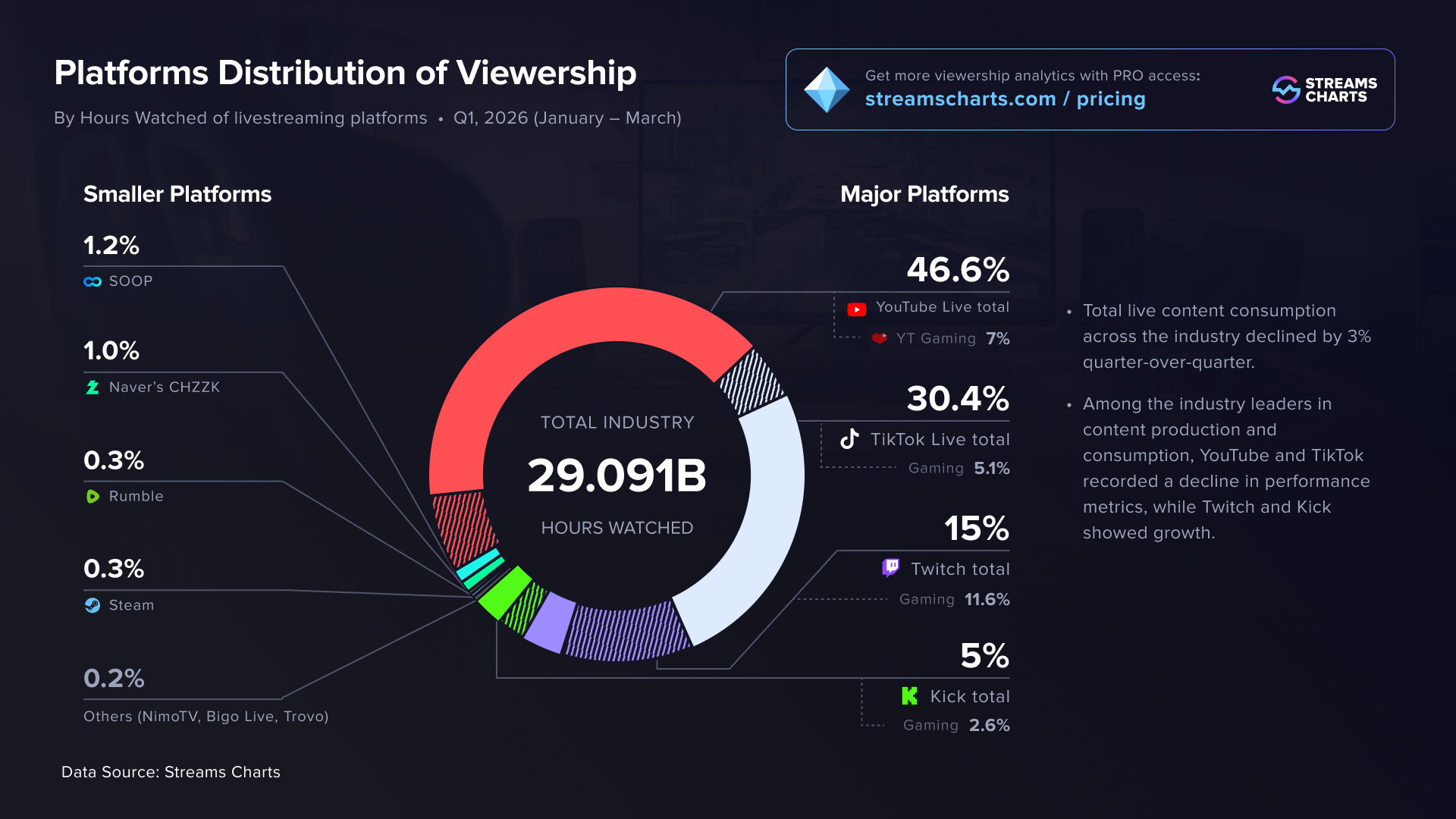
According to Streams Charts, total Hours Watched across the analyzed platforms surpassed 29 billion hours in Q1 2026. This marks a 3% quarter-over-quarter decline compared to Q4 2025, when total consumption stood at around 30 billion hours.
The primary driver of this downturn was a sharp drop in TikTok Live’s performance, with live viewership on the platform falling by nearly 12%. The decline began in late January and continued into early February 2026, aligning with the legal and technical separation of the U.S. segment under the TikTok USDS structure.
YouTube Live retained its position as the market leader in live content consumption, recording a slight decline in viewership of less than 0.3%. While this change falls within the statistical margin of error for a platform of its scale, it still amounts to a loss of roughly 30 million Hours Watched in absolute terms, making it a meaningful contributor to the industry’s overall decline.

Twitch posted the strongest growth among major platforms, increasing its Hours Watched by 4.46%. This growth was largely driven by the start of major esports seasons, particularly in League of Legends and Counter-Strike, which brought a surge of viewers. At the same time, the introduction of new in-game viewership incentives tied, for example, to Overwatch and Rocket League tournament cycles, helped improve audience retention and keep viewers engaged for longer periods.
Stake-backed service Kick also ended the quarter on a positive note, growing its Hours Watched by 1.79%. Similar to Twitch, the platform’s performance was heavily influenced by gaming content. Sports content, streams in the GTA RP category and League of Legends esports broadcasts served as key growth drivers, with the Brazilian LoL esports audience making a particularly strong contribution to overall viewership.

Moving on to smaller platforms, SOOP completed the consolidation of its streaming and content assets under a single brand in early 2026. This integration of Korean and global operations into a unified ecosystem was designed to streamline content distribution and monetization for creators. Despite these efforts, the platform recorded a moderate decline in live content consumption for the quarter.
As for SOOP’s main competitor, Naver’s CHZZK, it grew in viewership and successfully narrowed the gap with its primary counterpart. The difference in Hours Watched between CHZZK and SOOP decreased by 10 million, reaching 57 million. This growth was fueled by Winter Olympics coverage and League of Legends esports, where CHZZK currently leads SOOP in audience engagement metrics.
Rumble posted the strongest positive dynamics among smaller platforms with a 3.14% increase. Audience growth was supported by geopolitical instability and significant political processes in the U.S., which boosted reach for creators specializing in global and domestic affairs.
As for NimoTV, it continues to experience a downward trend in viewership. The platform shows a distinct consolidation of its remaining audience around a small group of top Vietnamese streamers, while overall reach continues to shrink.
Streams Charts has updated its Bigo Live database, with total figures now incorporating Chatting and IRL categories alongside gaming, leading to a recalibration of the platform’s baseline metrics.
Trovo reached an all-time low in viewership. This sharp decline and the subsequent exodus of creators followed an official announcement that the platform’s livestreaming functionality would be discontinued in the summer of 2026.
YouTube Live viewership statistics for Q1 2026

YouTube Live recorded an audience decrease in February, followed by a significant viewership surge in March, which effectively prevented a more substantial overall decline for the quarter. Primary drivers of this growth included Brazilian sports, specifically football, alongside Hispanic reality shows and various news segments. Within the platform's content landscape, the entertainment segment outperformed political coverage, though YouTube Gaming remained the largest individual category for live content consumption.

Although gaming remains the platform’s largest category by viewership, it recorded month-over-month declines throughout the entire quarter. January emerged as the peak period, bolstered by the M7 World Championship for Mobile Legends: Bang Bang, which remains a primary viewership driver on YouTube due to the game's significant following in Southeast Asia. Regarding individual channel performance, the American creator TheBurntPeanut secured the top position among all channels, surpassing even global star Darren “IShowSpeed” Watkins Jr.
TikTok Live viewership statistics for Q1 2026

TikTok recorded a notable decrease in viewership starting in February. While a direct causal link between this decline and the separation of its U.S. operations remains unconfirmed, data suggests a likely correlation. Our ongoing analysis continues to examine the causes of long-term viewership decline observed on the platform.
Regarding content, conversational broadcasts remain the platform's dominant category. Among gaming titles, Roblox emerged as the leading game for the quarter, outperforming the mobile titles that traditionally command the highest viewership on the service.
Twitch viewership statistics for Q1 2026

Twitch maintained a stable trajectory over the period, with a minor dip in February that did not significantly impact overall high engagement levels. Conversational broadcasts remained the dominant content category, while League of Legends outperformed Counter-Strike in total watch time among competitive gaming titles.
The quarter was marked by the dominance of U.S.-based creators in the viewership rankings. TheBurntPeanut secured the top position among all streamers, representing a highly successful start to the year for his multi-streaming endeavors.
Kick viewership statistics for Q1 2026

March became the most successful month for Kick, driven by a series of viral sporting events specifically focused on boxing and MMA.
The platform's leading creators display a demographic profile that differs significantly from Twitch. While U.S. streamers remained the primary drivers of viewership on Twitch, Kick’s top rankings were dominated by Jordanian broadcasters, reflecting a more diverse geographical spread among the platform's top-performing creators.
SOOP viewership statistics for Q1 2026

March was the most successful month for SOOP, with viewership primarily concentrated on League of Legends (specifically the Korean LCK league) and conversational broadcasts. Other titles popular in South Korea, such as StarCraft and PUBG: Battlegrounds, also demonstrated healthy engagement levels during the quarter.
Naver’s CHZZK viewership statistics for Q1 2026

March unexpectedly proved to be the weakest month for CHZZK during the first quarter. Although the platform maintains a more pronounced focus on gaming than SOOP, conversational broadcasts emerged as the most popular streaming category, followed by coverage of League of Legends, Minecraft, Overwatch and the Winter Olympics.
Rumble viewership statistics for Q1 2026

Rumble maintained steady dynamics throughout the quarter. The platform’s top channels consist exclusively of American influencers, with political commentators representing the vast majority. This leading group includes figures such as Alex Jones, Nick Fuentes and Dan Bongino.
Steam TV viewership statistics for Q1 2026

Steam TV maintained a stable performance throughout the first quarter, with March recording the highest viewership levels. This peak was driven by the release of Crimson Desert, as broadcasts featuring the viral title generated the highest viewership for the platform during the period.
Nimo viewership statistics for Q1 2026

NimoTV continues its viewership decline, with performance totals currently sustained by a small group of top Vietnamese creators. These broadcasters focus primarily on League of Legends content, which remains the platform's central driver for audience engagement.
Bigo Live viewership statistics for Q1 2026

Bigo Live’s metrics now incorporate non-gaming broadcasts, which have led to a significant increase in the platform's total reported figures. To ensure data integrity during this methodological shift, a comparative viewership dynamics chart was omitted for this quarter. The inclusion of these categories places the platform’s total audience engagement significantly closer to that of NimoTV.
Trovo viewership statistics for Q1 2026

Trovo reported the weakest results among all analyzed platforms, which aligns with the recent announcement to cease livestreaming operations in the summer of 2026. Following this news, the service experienced a significant departure of streamers and viewers, resulting in an all-time low for the platform's performance metrics.
Subscribe to our newsletter.
Latest streaming statistics and analytics news in weekly format!
SubscribeSimilar news
Mentioned channels