Rumble Explained: the livestreaming platform which aligned with Trump
While companies like Twitch and YouTube have built global livestreaming platforms hosting myriads of content, Rumble has established itself with a uniquely singular identity in the North American industry as a livestreaming platform for political commentary; which although potent, can leave the platform’s performance at the mercy of the news cycle.
Rumble, although established seven years earlier, saw a huge uptick in popularity in 2020. Following accusations of censorship from mainstream platforms such as YouTube, a wave of popular conservative politicians and celebrities jumped to Rumble for their livestreamed content. Since then, the platform has become a particular favourite for those on the Republican side of the American political spectrum.
Why was Rumble created, and how did it become a political platform?
In 2013, Chris Pavlovski founded Rumble as an alternative to YouTube, which had recently been bought out by Google. Pavlovski believed Google’s purchase of YouTube would kill the freedom of the platform and that the platform’s attention would shift away from smaller creators, so he sought to create an alternative which catered to independent creators.
“We launched in 2013 to compete in this market, and what we saw were platforms, in 2013, de-prioritizing small creators and prioritizing large influencers. We felt it was time to come into the market and help that small creator.” Rumble CEO Chris Pavlovski in an interview with Fox Business
During the 2010s, Rumble built itself a small fanbase. Its business model, which saw Rumble license the content uploaded by creators, allowed them to create their own highlight reels, which were posted to other social media. In 2019, the Rumble Viral YouTube channel reached over 1,000,000 Subscribers, marking a significant step in the brand’s history: but 2020 would bring the platform’s own defining moment.
Amid the COVID-19 pandemic, a wave of Republican politicians and celebrities migrated to Rumble for their social media content, with many of these figures citing censorship from YouTube as their reason for moving. Some of the most prominent names to join Rumble in this wave include Devin Nunes, Dan Bongino, and Sean Hannity. The following year, US president Donald Trump joined the platform for his election campaign.

Rumble’s new influx of Republican figures aligned with its ethos of fighting censorship and corruption, and according to their proponents, defending free speech. The company has fought hard to avoid punishing creators, exiting markets like Russia and Brazil over legal orders to suspend channels or content.
Rumble took Google to court over its place in the free market, bringing the company an antitrust suit in 2021: Rumble claimed that Google’s algorithms had been purposefully tweaked to suggest YouTube to users instead of Rumble, with Google offering no comment. Ultimately, the case was thrown out in 2025 after a California judge determined the suit was brought after the statute of limitations had expired.
Commercially, Rumble received investments from Peter Thiel, Vivek Ramaswamy and JD Vance in 2021, with the company valued at around $500M. It has also expanded beyond livestreaming, acquiring its own crowdfunding platform and forming an agreement with the Trump Media & Technology Group. In 2023, it was granted exclusive broadcast rights for the online broadcast of the Republican presidential primary debates.
Rumble’s success and reliance on political content have not come without criticism. Rumble’s position as a bastion of free speech has often been challenge, with The Washington Post designiating Rumble as a “home for anti-vaccine misinformation and conservative complaints about Big Tech censorship”, and the Rolling Stone magazine noted that “although anti-vaccine propaganda runs rampant on Rumble, as does liberal disdain, it labels itself as a ‘neutral’ platform”. With this in mind, what does the data say about Rumble’s content?
Who uses Rumble, and what do they watch?
Rumble’s content strategy is strikingly different from any competitor. Whereas nearly all livestreaming platforms rely on an assortment of content, Rumble almost exclusively generates its viewership through political content, especially that aimed at Republican viewers from the United States. Rumble’s top creators are not typical streamers, but radio hosts and commentators running scheduled daily broadcasts that more resemble a traditional talkshow.
The platform has attempted to branch into other areas in recent years, but its core audience remains focused on political content. In 2024, controversial livestreaming figure Guy "DrDisrespect" Beahm signed a deal with Rumble, where he has streamed since. Although previously one of gaming’s most recognisable creators, DrDisrespect’s viewership on Rumble amounts to a mere few thousand, far less than the top political commentators on the platform.
In other attempts to branch out, Rumble signed a deal with Thrill One Sports & Entertainment in 2023 to live broadcast their sporting events, including Power Slap, Nitrocross, and Street League Skateboarding. In 2024, Rumble also contracted massively popular North American creators Darren "IShowSpeed" Watkins Jr. and Kai Cenat to team up and host the Kai N Speed Show on Rumble. Although a short success, only lasting twelve episodes, this collaboration marked Rumble’s most popular non-political content to date, with the second episode generating 308,000 Peak Viewers, according to Streams Charts.
Rumble's most popular broadcasts by peak concurrent viewers
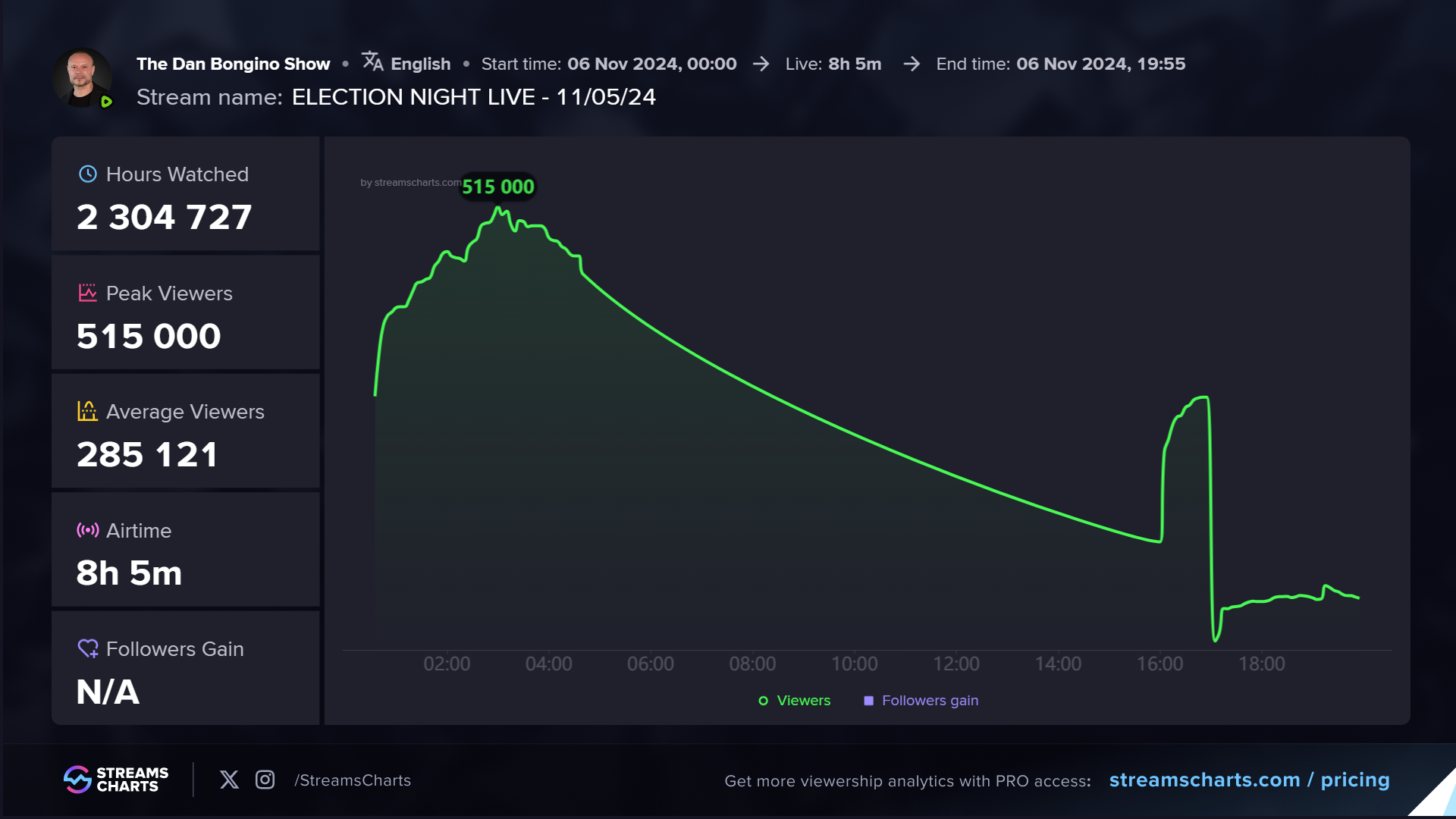
Rumble’s biggest waves in viewership have closely coincided with US political events, specifically those having to do with President Donald Trump. The most popular Rumble stream ever was Dan Bogino’s coverage of the 2024 election night results, for which he reached 515,000 Peak Viewers. Some of his other broadcasts also ranked among the most popular broadcasts ever, including a live fact check for Trump and Kamala’s debate on September 11 and an interview with Donald Trump the following month.
Andrew Tate also hosted one of Rumble’s most popular broadcasts on June 14, 2024, titled: “EMERGENCY MEETING - COUNTER ATTACK”. The broadcast took place just after four women came forward to accuse Andrew Tate of sexual assualt, a case which is still ongoing. Tate took to Rumble to air his side of the matter, for which his fans flew to Rumble to achieve 430,000 Peak Viewers.
Other top streamers throughout Rumble’s history include Steven Crowder, who earned 460,000 Peak Viewers on the election night in 2024, and the official GOP account. Turning Point USA also claimed a spot near the top for their All-American Halftime Show earlier this year: an alternative, protest show to the Super Bowl’s Halftime Show for which TPUSA received over 274,000 Peak Viewers on Rumble —- notably, the same event received over 4.86M Peak Viewers on YouTube Live.
Who are Rumble’s most popular creators?
Rumble’s creator leaderboard looks unlike any other streaming platform, reflecting political commetators and media personalities with roots in talk radio or television. Rumble’s focus on the USA is reflected in its top streamers. The most popular creators of Rumble, according to Streams Charts data, are all from the United States. This heavy link to the US has tethered Rumble’s performance to this country’s news cycle, with viewership waving or waning amid heavy news cycles.
Alex Jones was Rumble’s most-watched creator of 2026 so far. Jones used his Rumble channel to broadcast near-constantly throughout the year, allowing him to accumulate over 5.6M Hours Watched.

Dan Bongino, a radio host and podcaster who served as President Trump's deputy director of the FBI before stepping down a year later, returned to the talk show format through Rumble. Since his return, he has consistently ranked near the top of Rumble’s charts. Steven Crowder, who has worked to create exclusive Rumble content for years, and Nicholas J. Fuentes both finished off the top end of the ranking with over 3.5M Hours Watched each.
Other top creators on Rumble include other political commentators, as well as newsrooms and media organizations. Ultimately, all of the most popular content centeres around news, specifically US events, and political commentary.
Rumble in 2026: What comes next for Rumble
While Rumble is not competing in the same league as major platforms like Twitch, YouTube or Kick, it holds a strong spot in the livestreaming sphere, perhaps surprisingly given its mono-demographic audience.

Rumble finds itself behind the Korean platforms SOOP Korea and Naver’s CHZZK — which are both also only appealing to one nation — but ahead of all other livestreaming platforms tracked by Streams Charts.
The platform was one of the few smaller livestreaming platforms able to generate a positive quarter-on-quarter viewership dynamic for Q1 2026, according to our quarterly report. Rumble’s monolith audience has developed strong ties between its creators and viewers, beneficial for viewership, and it also benefited from the hectic news cycle surrounding the US to begin 2026.
However, as has been seen in the past, Rumble’s total viewership is heavily dependent on the news cycle. The previous US election cycle remains Rumble’s most popular livestreaming moments; the months leading up to the election night broke record after record for Rumble, until November 2024 set the monthly watch time record with over 62.8M Hours Watched. While some of the early 2025 months came close to this in popularity, as Trump’s term has progressed, viewership has slowly dwindled for Rumble.
For comparison, on other livestreaming platforms such as Twitch, political streamers also suffered from dwindling viewership after the hectic election cycle. For example, many political American streamers on Twitch such as Hasan “HasanAbi” Piker generated their most popular streams during the election cycle — Hasan generated his record of 313,400 Peak Viewers on election night 2024 — and have never come close to this level of attention since. While individual streamers can expand into other content or settle back into their new normal viewership, this is a more significant problem when faced by an entire platform.
Passionate esports fan, still waiting for TF2 to become a tier-1 discipline
Subscribe to our newsletter.
Latest streaming statistics and analytics news in weekly format!
SubscribeSimilar news
Mentioned channels